What Is the Process in Which Groundwater Becomes Surface Water Again
Water is arguably the most important resource on our planet. All life depends on information technology for survival. Approximately 71% of the surface of the Earth is water and of this, about 97% is saltwater. Where fresh h2o is nowadays largely depends on geology, geographic location, global weather processes, and topographic variability.
Water bicycle
Video courtesy of NBC Learn & National Science Foundation
Water moves through the environment adequately predictably in a progression known as the water bike (Fig. ane). Information technology "starts" when surface water (such every bit rivers, lakes, or oceans) becomes a gas and enters the atmosphere through evaporation, evapotranspiration (the conversion of h2o from liquid to gas via transpiration of plants and evaporation from soil), or sublimation (the process by which solid water changes directly to gas); the gaseous h2o condenses in the air and forms clouds. As the clouds build and the amount of water increases, it precipitates out of the atmosphere (commonly as rain or snow), landing on the ground or in h2o. Frozen water tin can be stored equally water ice and snow for a meaning period of time, simply like pelting, when it melts, it either infiltrates into the ground (becoming groundwater), or runs off the state surface into streams or lakes. Both streams and groundwater eventually recharge larger water bodies such as rivers, lakes, and oceans. Once at the surface, water "restarts" the bike every bit it evaporates dorsum into the atmosphere.
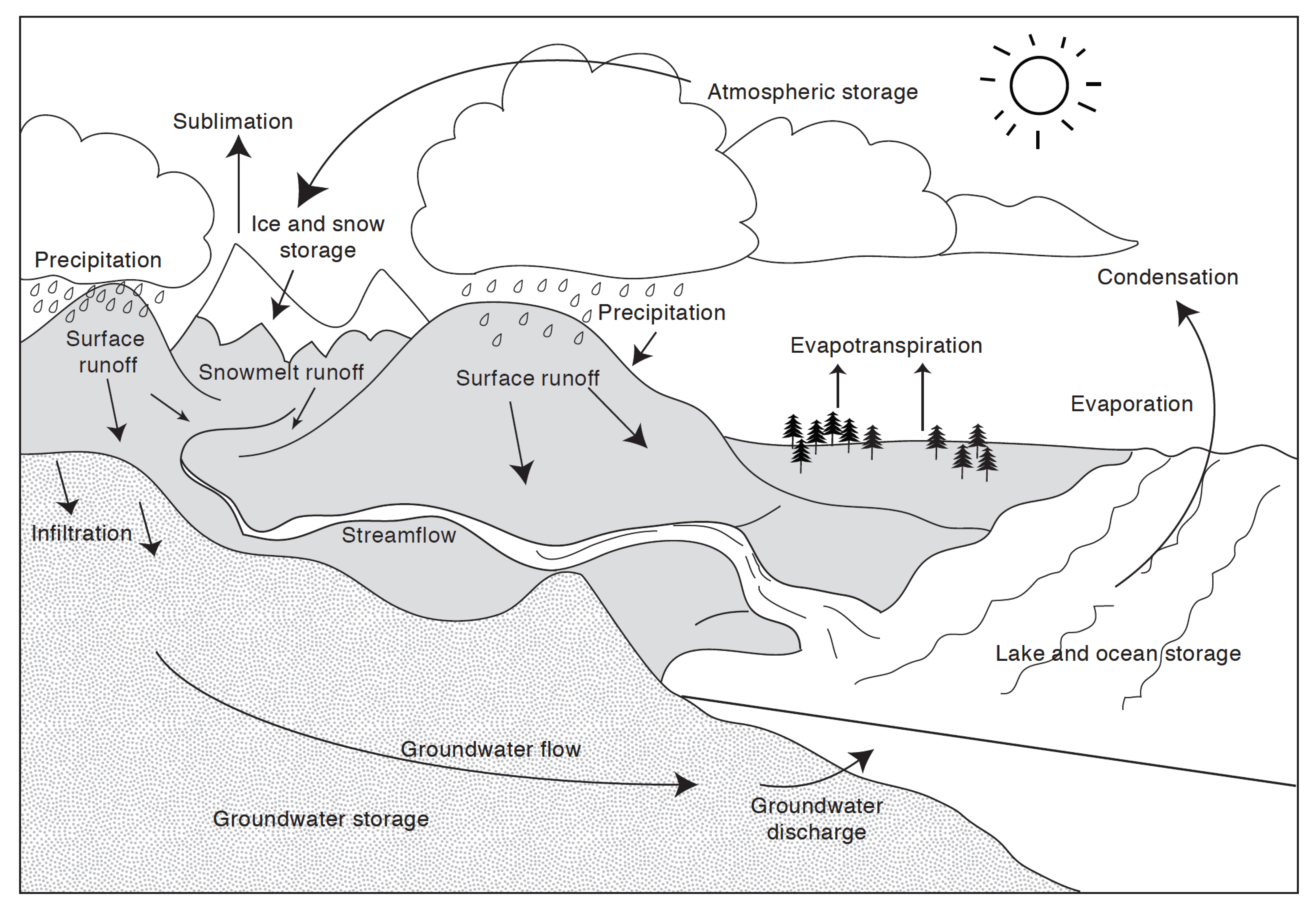
Reservoirs and residence time
Every bit mentioned above, there are numerous places, or reservoirs, where water is stored for varying lengths of time. The largest reservoirs are the oceans, which contain most 97% of the total water on the planet and are entirely saltwater. Fresh h2o comprises well-nigh 3% of full water, with the majority (69%) of that being stored equally water ice or snow (90% of which is in Antarctica). The next largest reservoir of fresh water, at xxx%, is groundwater. Surface-h2o reservoirs, such every bit lakes and streams, make upward 1% of fresh water, and the atmosphere stores but a tiny fraction.
How long h2o stays in each of these reservoirs (residence fourth dimension) varies from days (the temper) to thousands of years (oceans and some groundwater). Tabular array 1 shows the average residence times for each reservoir. It is of import to keep in mind that these are only averages and the actual range could exist quite broad. For instance, though seasonal snow might last several months, depending on the location and weather condition, some may sublimate inside hours or days.
| Reservoir | Residence time (boilerplate) |
|---|---|
| Oceans | iii,000 to 3,230 years |
| Glaciers | 20 to 100 years |
| Seasonal snow embrace | 2 to 6 months |
| Soil wet | one to 2 months |
| Groundwater—shallow | 0 to 200 years |
| Groundwater—deep | 10,000 years |
| Lakes | 50 to 100 years |
| Rivers | 2 to six months |
| Atmosphere | nine days |
Groundwater
Groundwater is an extremely important resource because we rely on information technology for much or most of our consumable h2o. It is the second largest reservoir of fresh h2o on Earth (30%). Groundwater sources that yield a significant amount of water are called aquifers (Fig. 2A). Aquifers are permeable bedrock (typically sandstone, carbonate, or fractured rock) or subsurface sediments (sand and gravel); the more than principal pore infinite (empty space between individual gains) and secondary pore space (empty space in rocks due to cracks and fractures) there is in these geologic units, the more than h2o tin be stored in them. Although the amount of pore space plays an important role in the amount of groundwater, subsurface water volume besides varies depending on geographic location, atmospheric precipitation amounts, flavor, or even human consumption; the water table (the upper surface of saturation) will rise and fall depending on these factors. Aquifers are recharged when precipitation or surface water infiltrates into the basis. There can exist multiple aquifers that overlie each other in the subsurface that are separated by confining layers called aquitards; these are layers of clay-rich sediments or non-porous rock that restrict the vertical flow of groundwater. An aquifer in which water tin can seep direct into it from the ground surface is known as an unconfined aquifer; these are typically recharged by atmospheric precipitation or stream and lake water infiltration. A confined aquifer is one that lies nether an aquitard and cannot receive recharge directly from the surface; instead, confined aquifers are recharged by water that infiltrates into the ground many miles abroad and flows into information technology (Fig. 2).

Groundwater is extracted from the subsurface past pumping from wells (Fig. 2B). These wells are constructed using large drills mounted on trucks. Depending on the type of material beingness drilled, reaching a productive aquifer can take a few hours to a few days. A pump is placed deep in the hole to force water up to the surface. When a significant amount of pumping occurs in one location and is drawing from a single aquifer, it can cause the water level surrounding the well(south) to lower, an outcome called drawdown (Fig. 2B), which can affect the water level in nearby wells, ponds, or lakes. If loftier pumping rates continue, the water level in the well tin drop below the level of the pump, and even nearby lakes and ponds can dry up. In one case pumping ceases, the aquifer may recover through recharge.
H2o in Minnesota
The location and climate of Minnesota bulldoze the distribution of water throughout the country. Minnesota sits at a drainage divide for three continental-scale watersheds, pregnant that near all water in Minnesota flows out of the state; therefore, Minnesota derives all of its h2o from precipitation. Most moisture falls in the state during the spring and summer months when warm, boiling air masses from the Gulf of United mexican states tin penetrate farther north. Withal, a large amount of groundwater recharge occurs in the spring and autumn when there is less water loss from evapotranspiration. For this same reason, snowmelt in the spring contributes to a significant corporeality of groundwater recharge. Located in the central U.s.a., Minnesota sits between the semi-humid and semi-barren climates of the east and west. This ways that there is a large gradient of water availability from west to e beyond the state. The western edge of the country experiences more than evapotranspiration than is replenished by precipitation, leading to drier environments. The eastern half of the land is the opposite, with greater annual precipitation amounts relative to the amount of evapotranspiration; this creates an surroundings with large forests and extensive wetlands.
H2o apply in Minnesota
Here in Minnesota, we have an abundance of h2o; with our "10,000 lakes" we are no strangers to this important resource. Only why is this so important? How practice nosotros use the water bachelor to our community, and how much does everyone really use? Figure 3 shows the primary water uses in the land, too equally the percent of water consumed past each grouping.

Domestic (personal) use may seem like the well-nigh obvious fashion we consume h2o, because nosotros utilise it every day; however, it only makes up eight.1% of the total water usage in Minnesota. Of the total amount of water used domestically, about 70% is from groundwater and the remaining 30% is from surface water (the Twin Cities are the chief consumers of this surface water). While some domestic water utilize is cocky-supplied to consumers via private wells, the majority of the population, about 79%, relies on the public h2o supply for their everyday needs such as drinking, cleaning, bathing, and cooking. Watering yards and washing cars also account for a portion of this consumption. The average Minnesotan uses about 63 gallons of water per twenty-four hours; that's about the amount needed to fill a standard bathtub! An average family of 4 uses about 252 gallons of water every twenty-four hour period. This may not seem like a lot, merely when you consider how many people live in the state (about 5.5 million), information technology really adds up; that'due south 5.5 meg total bathtubs, or over 345 one thousand thousand gallons of water used every 24-hour interval, just by people living their normal lives! Other uses of public-supplied h2o in Minnesota brand up nigh 6.5% of full consumption, and include services such as public pools, parks, firefighting, wastewater handling, municipal buildings, and some industrial employ. About 3.5% of total water consumption is cocky-supplied by industries for uses including washing, processing, dilutions, cooling, and sanitation.
By far the largest consumer of h2o (65.7% of total water utilize) in Minnesota is thermoelectric power. About 100% of the h2o is from surficial sources and is used exclusively for cooling systems. About 62% of this is used for one time-through cooling, is not consumed by the found, and is returned directly to the withdrawal source; the remaining 38% is used in recirculation cooling systems, meaning information technology is recycled by the constitute until it somewhen evaporates and is returned to the surround as steam. In this way, though thermoelectric ability uses the highest per centum of h2o, it does not actually consume the whole corporeality.
Mining practices utilize 7.4% of the total water Minnesota. Historically, mining has played a large office in the economic and cultural growth of the region. Today, large mines produce taconite and other materials that are sold and shipped across the globe, making the industry an important contributor to the Minnesota economy. Water is used for the extraction of ore through practices such as quarrying, milling, h2o injection, and dampening roads for grit control.
Irrigation accounts for 5.2% of the full water consumption in the form of sprinkler and surface irrigation, and about 87% of withdrawals for irrigation are from groundwater reservoirs. If there is a big amount of pumping on a single aquifer, then there could exist a problematic water-level decline (Fig. 2B). The main employ of this resource is agronomics; however, golf courses and parks are besides included in this category. Commonly, water used for irrigation is mixed with fertilizers, manure, and pesticides that are intended to nourish and protect crops or grasses. Whatsoever water (including these additives) that is not consumed past the plants either runs off into nearby streams or ponds, or re-enters the groundwater reservoir. This contaminated water is often high in nitrate, which if consumed by humans can pb to health problems, especially in infants and pregnant women. In areas with potentially loftier nitrate concentrations, the Minnesota Department of Health enforces federal regulations on preventing and treating nitrate contamination in drinking water (the Safe Drinking Water Deed), and public water systems are routinely monitored and treated for contamination. Nitrate does occur naturally in small amounts when microorganisms in the soil break downwardly organic affair; nevertheless, in these concentrations information technology is non considered harmful.
Livestock and aquaculture (raising organisms for food, conservation, or sport) account for 1.nine% of full water consumption in Minnesota. The h2o is used for habitat, watering, sanitation, and cooling facilities.
Humans are non the only organisms that require water. Minnesota has numerous ecosystems that rely on the abundance of h2o present in the surround. The numerous lakes, lush forests, peat bogs, and aquatic habitats all require groundwater and surface water resources to maintain skilful health.
Lastly, though it tin can't be quantified, water is used for recreation. Minnesota is known for its "10,000 lakes," rivers, the Boundary Waters Canoe Area Wilderness, boating, and fishing. Outdoor recreation is very popular among Minnesotans, and our water resources are a large part of that. Not only are these activities of import to residents of Minnesota, but they as well concenter tourists from other states. Co-ordinate to the U.S. Department of Agriculture, the Boundary Waters Canoe Area Wilderness lone attracted 146,177 total visitors in 2015; and in 2022 there were ane.6 one thousand thousand licensed anglers in Minnesota! Those who savor these types of activities know the value of Minnesota water resources and recognize the importance of protecting their quality and integrity.
hanselmanwitelabacter.blogspot.com
Source: https://cse.umn.edu/mgs/water
0 Response to "What Is the Process in Which Groundwater Becomes Surface Water Again"
Post a Comment