Oregon State University Post Bacc Computer Science Reviews
Every once in a while, people email me to ask whether Oregon State's postal service-baccalaureate estimator science plan is worth it. Now that I'grand nearing the end (I'll graduate at the stop of winter term), I feel like I tin provide an reply. This post will serve as a long-form caption of my answer, which is yes (with some caveats).
Me
Earlier jumping into this, a short background about me to give you some context on the thoughts below: I'm a old elementary school instructor who wants to transition into educational activity computer scientific discipline. I started the program in the autumn of 2016, and volition graduate next term, which puts me on a more-or-less 2.5 twelvemonth track. I think information technology'due south of import to say (at the expense of tooting my own horn) that I've done well in the program, by which I mean I've earned all A's and so far (though parallel programming (CS 475) was close).
I worked total-time during my first twelvemonth in the programme only haven't worked for the past twelvemonth and a half. My only other fourth dimension commitments too the Oregon Land plan are taking care of my daughter, volunteering ane afternoon a week, and taking math classes (one or 2 per term) at Portland Customs Higher and Portland State.
Costs
First of all, when nosotros say "worth information technology," what'due south 'it'? What are the costs? In my mind, the toll of doing this program tin can be broken down into three parts: financial price, time cost, and opportunity cost. Financial cost is the easiest to quantify, then let's outset with that.
Fiscal Toll
The fiscal cost breaks downwardly similar this: sixty credits at $487 per credit (every bit of Fall 2018), which works out to only under $30,000 in total (minus fiscal help, if you lot're eligible). On top of that, there are a few additional costs, like testing fees, textbooks, etc. I didn't proceed close runway of these, but they probably worked out to a few hundred dollars over the course of the program.
Fourth dimension Cost
Oregon State recommends setting aside 20 hours per week, per grade. There are 15 courses in the program, each administered over x weeks (viii weeks for summertime courses). This works out to 200 hours per course, or 3,000 hours for the unabridged program. Of course, these 3,000 hours could be broken up over one, two, 3, or more years.
In my feel, 20 hours per week per course was at the upper cease of the fourth dimension commitment required for my courses. My near intensive term, time-wise, was probably the summer before last when I took data structures (CS 261) and assembly linguistic communication (CS 271). These courses combined took around 35 hours per calendar week. That said, this was on the shortened summer schedule.
All together, I'll bet that I've spent about 12 hours per week, per class, on average, which will piece of work out to effectually 1,800 hours for the entire program.
Opportunity Cost
Opportunity price is the loss of potential gain when one alternative is chosen. In physical terms, this represents the wages yous won't be earning while in the program, or the time you won't be spending with your family, or whatever. This is obviously a factor for everyone, to varying degrees.
In Full
All together, these costs piece of work out to $30,000 and somewhere around one,800 hours. When I finish at the end of next term, what will I have to testify for them? Will it all have been worth it?
Benefits
Whether or non the program is worth it essentially only boils downward to 1 question: is working equally a software engineer (or in a related C.S.-focused career) worth the costs outlined above? If so, then program is worth it.
But put, I believe that completing the plan leaves you well-prepared for a career working in software engineering. I can attest to this, having recently completed an internship at Insitu. And many, many other people who have completed the programme tin attest to this, too. Alums of the program are working all over the place. A quick spin through my LinkedIn connections shows alums working at Google, Intel, Amazon, Salesforce, Boeing, Insitu, and on and on. In short, a computer science degree from Oregon Country probably isn't going to be a limiting factor in your task search.
Caveats
Now, some caveats. The main force of Oregon State's calculator science program is not the video lectures, it's not the instructors, it's not the assignments or other learning materials. The main force is this: making a commitment to spend a clamper of your life focusing on computer science and software engineering.
It almost goes without saying, only yous're likely to find amend educational materials on YouTube and at the public library than you're going to become for $487 per credit at Oregon Country. In some cases, way better. But who decides to quit their job and spend two years going to the library five days a week in club to switch careers? And even if you tin justify that to yourself, tin you justify it to your family? Volition they wonder whether you lot're wasting your time?
That concluding point gets at an important point: legitimacy. In some sense, that's all a diploma really is. It's just an system (similar Oregon State) willing to vouch for your expertise.
Caveats²
When I wrote above that the learning materials and the instructors are non a strength of the plan, perhaps I wasn't harsh enough. In fact, a lot of the learning materials are bad.
This doesn't apply to everything, of course, but some of the courses are very disorganized, many of the lectures are painful to watch, a lot of the assignments are simply mind-numbingly deadening. This can be particularly frustrating since informatics tin be so fun and interesting.
Take Software Engineering II, for example, which focuses on testing, debugging, and version command. I got really fired upwards about unit and integration testing over the summertime, then I was excited to spring into this course. In the finish, though, I establish it the be the most 'meh' grade in the programme. Y'all're given an old C codebase and asked to write some unit of measurement tests, some random tests, etc., so to write up reports near what yous found. This may mirror working in the industry, but I idea it would've been much more fun to care for the testing assignments as a kind of whodunit. Equally in, here's a weird affair with this program, run across if you tin blueprint a test suite to take hold of it.
That's but one thought nearly one course. If you're curious about what the other courses in the program are like, bank check out what I've written about them.
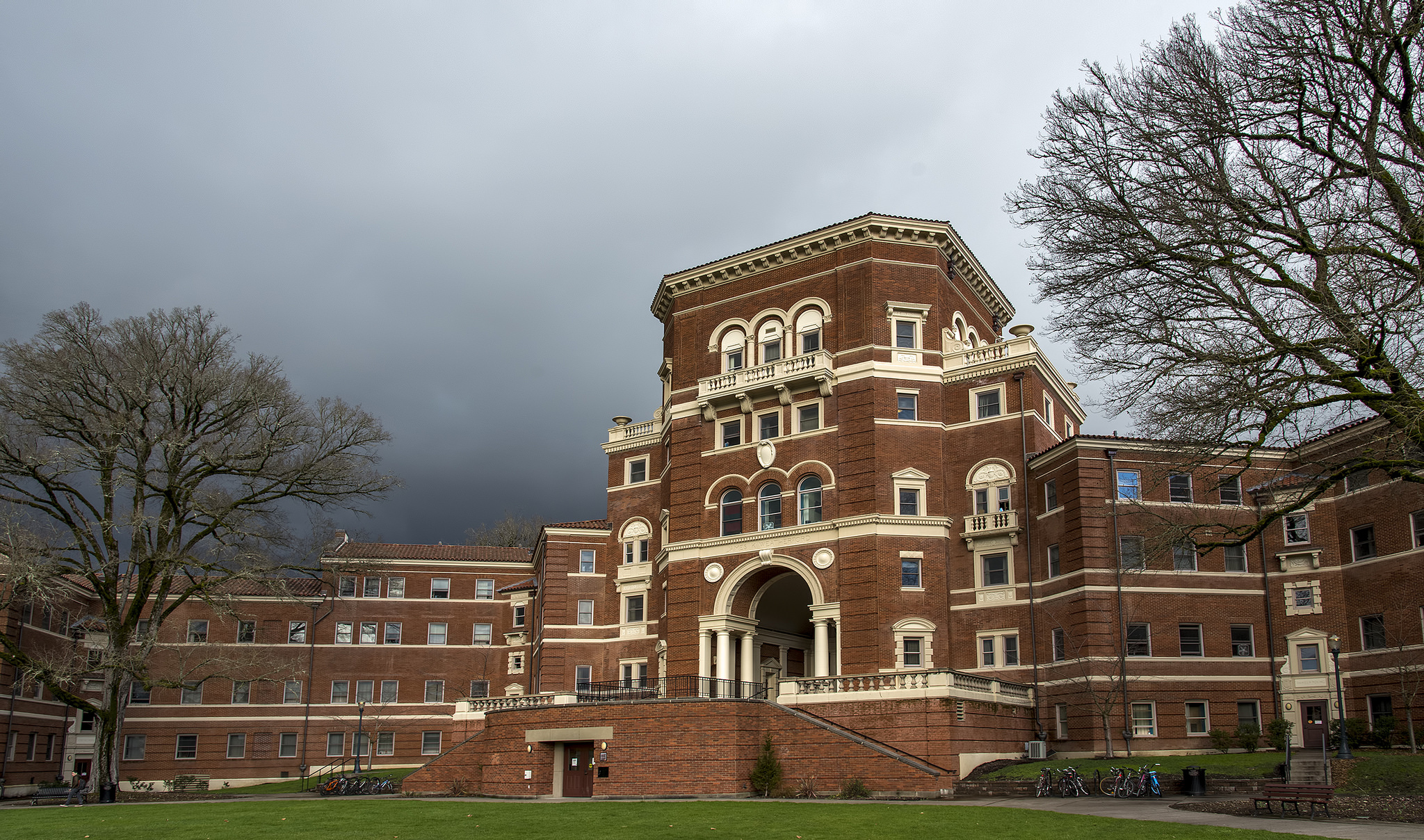 Random image of a building at Oregon State to break upwardly this long mail service. Photograph by Al Example.
In the aforementioned vein, there are a number of instructors who left me wanting. Information technology was as if they were simply administering a class rather than actively teaching information technology. This is certainly compounded by the fact that most of the people who I had as instructors did not actually design the courses they were teaching. So you'll have your "instructor," only when you pull upward the lectures information technology'll be someone else'southward voice from like five years ago. For the price of the program, I felt like Oregon Land could practise better.
All of that said, it's worth pointing out that there are some fantastic instructors, too. I can't say enough good things about Tim Alcon, Benjamin Brewster, and Stephen Redfield. These instructors really care nearly their students' learning. You can feel information technology.
I know based on my experience equally an educator that designing an academic program and education it is really, really difficult. Certainly harder than many of the concepts addressed in the program. And and then I think it's important not to be also disquisitional. But again, there's some depression-hanging fruit (standardize how courses are administered in Canvas, update and amend lecture videos, hire more than passionate instructors, etc.), and I promise that the programme administrators attain out and grab it.
Let's Wrap
I've said enough. Hopefully in the procedure I've made the case for why I think Oregon Land'south mail-bacc computer science program is worth the time and money if you want to work in software or a related field. Are there alternatives? Certain. Hit the books at the library, enroll in a bootcamp, etc. Simply for me, none of those options would've gotten me to where I am today. And that's precisely the point.
Update: Apr 2, 2020
I received an email today from Benjamin Brewster, who was an instructor while I was in the programme, and is now the manager of the programme. He's besides a really awesome man, and I want to be able to teach like him some twenty-four hour period.
Anyway, he provided the post-obit update: "At this betoken, we've redesigned most of the courses, and are finishing the rest in the adjacent couple terms. Nosotros've also added several new courses, and about doubled the instructor count. Big changes as things move forward!"
I'm not sure how authentic this post withal is, but I imagine that things at Oregon Country are only improving. And for what information technology's worth, I notwithstanding stand up by the claims I made when I wrote this a couple years ago.
hanselmanwitelabacter.blogspot.com
Source: https://alxmjo.com/is-osu-post-bacc-worth-it
0 Response to "Oregon State University Post Bacc Computer Science Reviews"
Post a Comment