During the Weimar Years This German Art School First Taught Classes in Performance Art
The Staatliches Bauhaus opened in 1919. It was shut under pressure from the Nazis in 1933. In the years between, its teachers synthesized a greatly influential ethos of the well-designed, mass-produced object.
Even every bit Bauhaus aesthetics have receded into the past, the Bauhaus outlook has renewed and expanded itself in the most-century since its birth.
Bauhaus Backstory
Several historical factors converged in the Bauhaus. Industrialization and the emergence of the "mass man" — huge urban working- and middle-form populations — gave rise in the 19th century to the want for beautification. Material progress was outpacing livability. Urban center life was oftentimes banal and ugly.
Artists and designers reckoned with the problem of adorning the homes and lives of the swelling urban masses. This trouble contained both aesthetic and material challenges.
The aesthetic challenge was that of style: What kind of beauty suited modern life? Initial answers were nostalgic, yearning for idealized rustic, medieval and folk styles. These resulted in factions such as the Pre-Raphaelite Brotherhood and the Arts and Crafts Movement.
Later, Art Nouveau began to integrate astern-looking themes with the sinuous lines of the Auto Age. Art Deco followed, celebrating industrialization itself in its imagery and motifs.
The fabric challenge of mass adornment was equally daunting. The objects produced past the new breed of creative person-designer should, ideally, be available to the mutual person. Yet, the skilled craftsmanship that had always defined quality appurtenances placed their prices out of attain.
In halting steps, the processes of industrial mass production were applied to humble commonsensical purposes. Automobile-shaped metallic, and glass replaced hand-carved woods and stone. The beautiful object lost its handmade individual charm. But it became accessible to the full general population, whose alienating urban landscape demanded it.
Globe War I devastated Europe. Until the war, a refined high culture notwithstanding helped to ascertain aesthetics and moderate the winds of alter. After four years of brutal mechanized warfare, the delicate Old Earth lay in ruins.
A reeling continent was ready and eager to explore radical new blueprint theories and products. It was against this properties that architect Walter Gropius founded the Bauhaus, in Weimar, Deutschland, in 1919.
The Vision
The Bauhaus followed a utopian concept, a mission to completely design and define modern life. Its doctrine went beyond the integration of form and function, seeking to fuse all branches of art and design into a seamless, harmonious whole.
In his founding manifesto, Gropius wrote, "Let us … create a new guild of craftsmen without the class-distinctions that raise an arrogant barrier between craftsmen and artists! Let us desire, conceive and create the new building of the future together. It volition combine architecture, sculpture and painting in a unmarried form, and will ane twenty-four hour period rise toward the heavens from the easily of a million workers equally the crystalline symbol of a new and coming organized religion."
Nevertheless in that location was no compages course. Gropius' gigantic ambition was ridiculously mismatched with the resources available to him. The school suffered the poverty of defeated Germany in its early on years.
When information technology opened, the students were starving and the classrooms had no desks. They squatted on the floor in unheated studios.
Undeterred, Gropius designed a curriculum and assembled a set of teachers to execute information technology. In its Weimar period, the Bauhaus had between 150 and 200 students. High proportions of women and non-Germans were admitted.
At that place were no academic requirements to enter the basic course, an introductory study of materials, although passing that course — a requirement for progressing further — was difficult. The teachers of this curriculum over the lifespan of the Bauhaus did much to set up the tone of the school during their tenures.
Playing Up Strengths
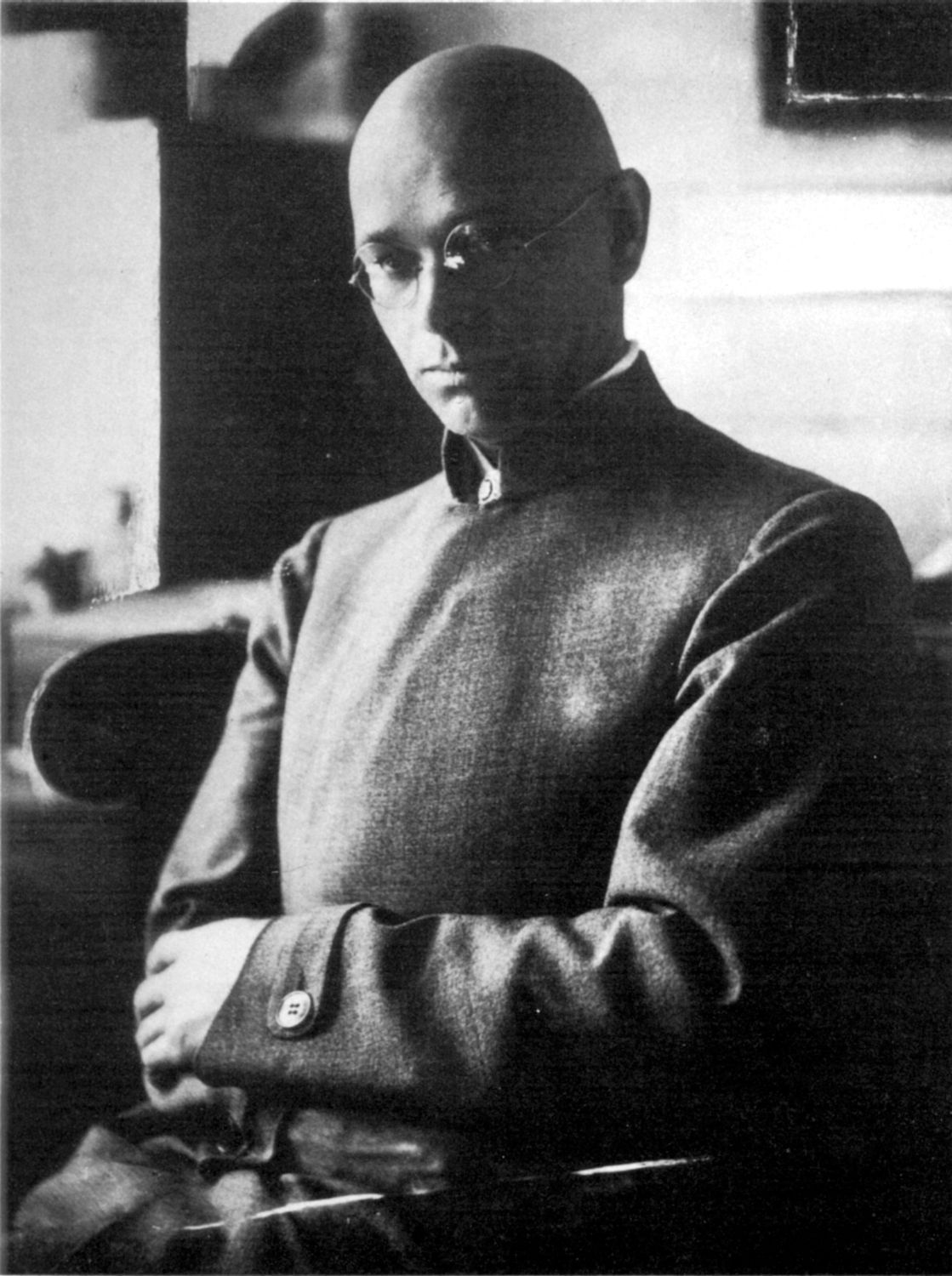
The first of the basic grade instructors was Johannes Itten, a Swiss artist trained every bit an uncomplicated schoolhouse teacher. He was a follower of the ideas of Friedrich Fröbel, the "inventor of kindergarten," who had proposed the then-radical idea that children learn and thrive through play.
Itten applied this concept to his course, introducing gymnastics, meditation and breathing exercises into the classroom. Actual piece of work involved "playing" with pieces of wood and metal, glass and stone, dirt and fabric. The play involved transforming and assembling the materials with the aim of discovering their properties individually and in conjunction with i some other.
Itten guided the play to teach his students principles of form and color and to help them focus on the specific media to which they were all-time adjusted. He saw his task as transmitting concepts and practices of art and blueprint to his students while simultaneously encouraging and developing their individual creativity and expression.
Itten was deeply skeptical of modernity. In the introduction to his book, Design and Form: The Basic Course at the Bauhaus and Afterward, he wrote, "The terrible events and the shattering losses of the war had brought in their wake confusion and helplessness in every walk of life. … I became aware of the fact that our scientific, technological culture had reached a disquisitional point. I did not believe that the slogans 'Back to the Crafts' or 'Unity of Fine art and Technology' were capable of solving our problems."
Itten found his answers in Eastern philosophy, Zoroastrianism and early Christian theology. His mystical leanings gradually brought him into conflict with Gropius, and Itten left the Bauhaus in 1923.

Integration of Disciplines
With Itten's deviation, the expressionist menstruum of the Bauhaus came to an end. Henceforth, students were not to be encouraged toward the extremes of personal vision and idiosyncrasy. Rather, they were to be indoctrinated in a more than universalist fix of ideas and practices.
Gropius found in Hungarian photographer and painter László Moholy-Nagy a partner in this program. Moholy-Nagy was a communist and shared the technological optimism of communists of the period. He wholeheartedly believed in the marriage of art and technology, in service to the creation of a healthy man future.
In his volume The New Vision, From Cloth to Architecture he described his approach to the Bauhaus bones course: "Their training this first year is directed toward sensory experiences, enrichment of emotional values, and the evolution of idea. The emphasis is laid not and so much on the differences between the individuals but more than on the integration of the common biological features and on the objective scientific and technical facts."
In actual practise, Moholy-Nagy'southward form was not that different from Itten's, although it involved more collage. The difference in effect derived from Moholy-Nagy's concept of the goals of his lessons and the way he explained to his students what they were doing in his grade.
Artist-Craftsman Fusion
Moholy-Nagy shared direction of the preliminary course with Bauhaus graduate Josef Albers, who took it over entirely in 1928 when Moholy-Nagy departed the school. Similar Moholy-Nagy, Albers subscribed to Gropius' utopian-fusionist design doctrine, shaping his pedagogy around the centrality of marrying properties and uses of materials.
Other notable artists who passed through the Bauhaus during its curt but intense existence included Paul Klee, Wassily Kandinsky and Oskar Schlemmer. Schlemmer'southward work and didactics ably demonstrate the impulse of the Bauhaus to cultivate universalism in fine art and design: He taught wall painting; rock, forest and metallic sculpture; and life drawing.

He produced pregnant work as a graphic designer and adman, nevertheless a key passion for him was the phase. Schlemmer designed and choreographed ballet, worked with Stravinsky and directed the national bout of the Bauhaus stage program in 1928 and 1929.
He exemplifies the universal Bauhaus "artist-craftsman." But the appearance of Nazism bankrupt his spirit. His friend Max Neb wrote that in Schlemmer's concluding x years it seemed that a "mantle of silence" had descended upon him. He died in hospital in 1943.
In this, too, he exemplifies the Bauhaus. It existed on borrowed time, weathering constant assault from proto-Nazi and Nazi factions until its premature demise.

Designs for Mass Production
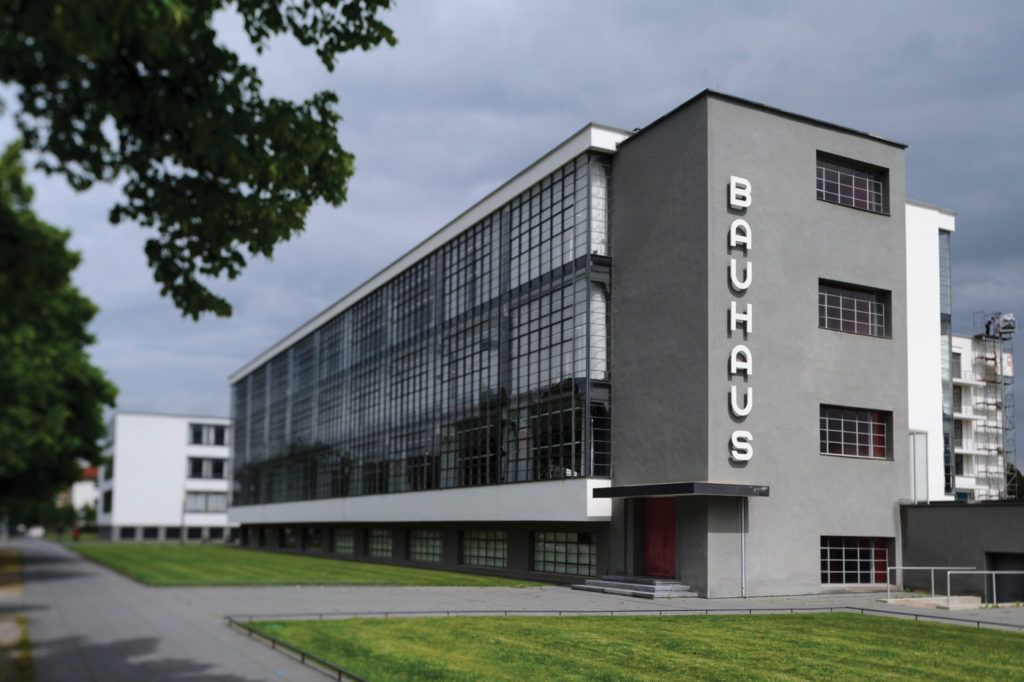
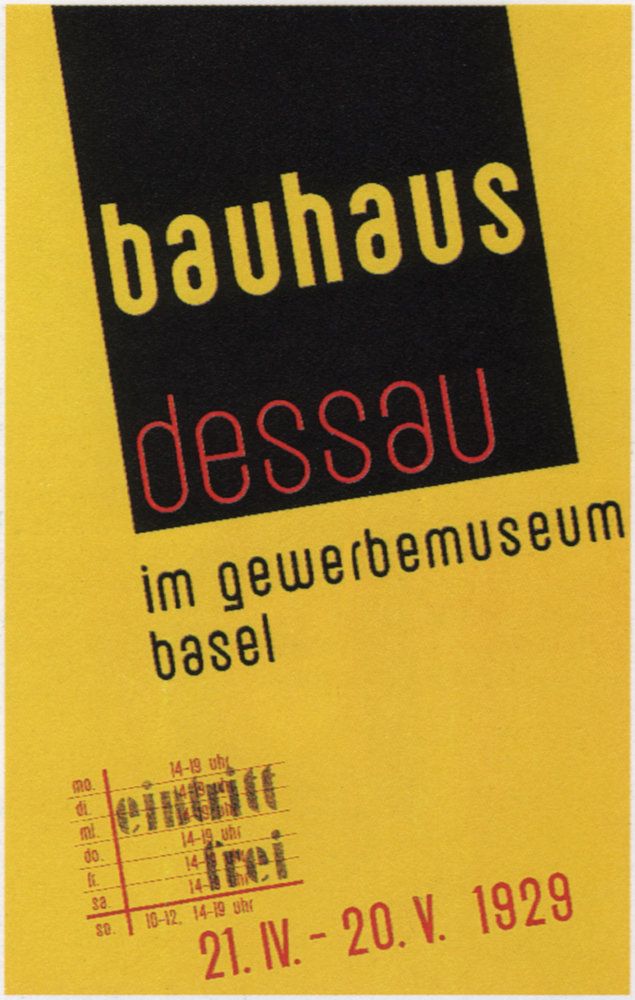
Under political and financial force per unit area, the Bauhaus moved from Weimar to Dessau in 1925. Gropius designed the new school building, a masterpiece of Bauhaus modernism. The architect Hannes Meyer replaced Gropius as manager of the school in 1928.
Nether his management, the school increasingly focused on the problems of design for the age of mass production and produced work that constituted a meaning income stream. He enthusiastically embraced the school's wallpaper program, creating educatee competitions for inclusion in the official Bauhaus wallpaper collection.
Of all the commonsensical designs the schoolhouse produced, the wallpapers were the near profitable. The school finally began to run in the black in 1929.
Political Challenges
In 1930, the architect Ludwig Mies van der Rohe replaced Meyer, shutting down the school's manufacturing activities in order to make didactics more key to its program. When the Nazis took over the Dessau city council, they moved confronting the school.
Two main sources of animus fueled the consistent opposition of the Nazis to the Bauhaus: On the one manus, the Bauhaus provided a friendly environment for communists, whom the Nazis detested. On the other hand, Bauhaus aesthetics reflected a cosmopolitan modernism, which the Nazis railed confronting as "degenerate" and "un-German." The city council ordered the Dessau campus to shut downwards.
In 1931, Mies paid out of pocket to rent an abased telephone factory in Berlin every bit a new school facility. During this short last period of the Bauhaus, students and teachers worked together to redesign the interior of the building.
Little further work was done before the Gestapo close the school. Although the decision was rescinded, the assistants decided to dissolve the Bauhaus, and the experiment in art education came to its close in 1933.

Standing Impact

During its 14 years of performance, the Bauhaus produced a small number of iconic designs, amid them Marianne Brandt'southward ashtray and java/ tea fix, Marcel Breuer's tubular-steel and fabric "Wassily chair," Josef Albers' stacking tables and, of form, the wallpapers.
These objects were distinguished past a reliance on basic geometric forms — the cube, the cylinder and the sphere — and a strict analysis of the minimum design requirements of the job of the object. Their very sternness reflects a nearly comical hypermodern flair.

Architecture produced past the Bauhaus has the same quality: spare, logical, rectangular structures involving a great deal of steel and glass. Given its cursory life and relatively small output, the Bauhaus has had a massively asymmetric impact on all fields related to its work.

Itten'due south original pedagogical template, which accessed inventiveness past applying the kindergarten concept of play to adult materials and considerations, defined not merely the preliminary courses taught by his successors simply many of the basic assumptions of art education afterward.
The clean, unadorned look developed by Bauhaus designers spread everywhere in modernist pattern. Cities around the world, from Chicago to Tel Aviv, began to prove Bauhaus influence in their architecture every bit refugees from the school spread across the earth.
Today, nigh a century later it was founded, the Bauhaus has sometimes been supplanted as the key influence in architecture, industrial design, typography and many other disciplines in which it one time held sway. Yet post-Bauhausian work in these disciplines exists, at to the lowest degree in part, in response to the Bauhaus. It is such a pivotal part of the history of aesthetics that its principles must exist answered even by those who disagree with them. Nosotros all live in the shadow of the Bauhaus.
Dear Information technology … Love Information technology Not
As an art critic, I find the Bauhaus is almost tragically frustrating. I adore every unmarried thing about the school: its fractious, brilliant kinesthesia, its fanatical educatee trunk, its radical sense of play and experimentation. I adore the willingness to have risks, to attempt annihilation, to tackle everything, to challenge inherited assumptions about all rules of aesthetics.
Notwithstanding I tin hardly stand up a single Bauhaus object. I find the Bauhausians' sense of design clunky and irritating. The colors and shapes are overstated to the point of being grating. The then-called utility of their objects involves design parameters and so farthermost as to return the objects unpleasant to actually look at or apply.
Their buildings strike me as mechanistic and vaguely hostile to the people who actually have to occupy them. Their zeal for elimination eliminated, in a higher place all, every gentle impact that makes bare functionality endurable.
Still, they will not be denied. I clothing a sentry transparently ripped off from Max Bill'south designs for Junghans. I love those clocks.
Article written by Daniel Maidman and beginning published in Artists Magazine. Get your subscription now and never be without the fine art-axial stories, inspiration and instruction you dearest.
hanselmanwitelabacter.blogspot.com
Source: https://www.artistsnetwork.com/art-history/the-bauhaus-effect/
0 Response to "During the Weimar Years This German Art School First Taught Classes in Performance Art"
Post a Comment