The Truth About the Harry Quebert Affair Review
The Truth Virtually the Harry Quebert Affair is a long merely fast-paced volume that walks the line betwixt airport novel and true work of literary fiction.
The Truth About the Harry Quebert Affair by Joël Dicker. Translated from the French past Sam Taylor. Penguin, 656 pages, $18.00.
By Troy Pozirekides
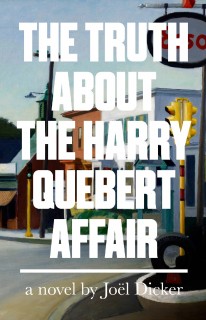
It'due south difficult to imagine a novelist these days who could "wander the streets of Manhattan, causing a stir" as he passed by, merely that'southward just what happens to Marcus Goldman, early on in Joël Dicker'southward new volume, the Truth About the Harry Quebert Affair. Dicker has himself been causing a stir of late; his novel's translation rights have been sold in 32 countries. The American edition, translated from the original French by Sam Taylor, has been chosen "unimpeachably terrific" by the New York Times Sunday Book Review, its author a "literary wunderkind" who "doesn't even accept the decency to write dreck."
That's loftier praise for a 29 year-one-time novelist, only Dicker'southward book, at to the lowest degree on the surface, would seem up to the job. Its narrator, Marcus Goldman, is himself a literary phenom who, afterwards the metoric success of his first volume, finds himself faced with the writer'southward affliction. Marcus is blocked, so he seeks solace in the company and wisdom of his mentor, the rough and tumble Harry Quebert, whose own volume The Origin of Evil fabricated him a household name upon its publication in the 1970s.
Marcus's brief sojourn to Harry's seaside cottage in fictional Somerset, NH doesn't accept the expected result, however — he still can't find something worth writing about. He returns, tail betwixt his legs, to New York, to face his publishers and risk breaching the stipulations of his contract. Just soon afterward, shocking news comes from Somerset: Harry Quebert has been arrested on suspicion of murder, after a trunk has been found cached in his lawn.
Marcus returns to Somerset, ostensibly to clear his mentor'south proper noun, but also to dredge upwardly material for a potential new book. We watch as he plays detective (along actual New Hampshire Land Police detective Perry Gahalowood, who is straight out of a buddy cop motion-picture show) but no existent sleuth'due south insight is always required of him. Marcus is the constant beneficiary of bumping into the right people at the right time, and nosotros gradually get a basic outline of what's happened: the girl who was cached in Harry'south thou is one Nola Kellergan, who went missing at the age of fifteen in the summer of 1975, just before Harry published The Origin of Evil, which is about the impossible dearest thing betwixt an older human being and a young daughter.
The deck seems to exist stacked against Harry from the kickoff; in addition to the damning testimony of The Origin of Evil — at present facing censorship from the schools and libraries that one time praised it as a quintessential piece of work of American fiction — Nola was found buried with a typewritten manuscript of the novel, with the inscription "bye my darling Nola" written right on the embrace page. Marcus, still, isn't convinced. He sets himself to discovering what really happened on August thirty, 1975, the date of Nola's disapperance, deadlines and all other concerns be damned.
The upshot is a long but fast-paced book that walks the line between airport novel and truthful piece of work of literary fiction. Unfortunately, this ambiguity of grade damns The Truth Virtually the Harry Quebert Affair from the beginning. It's fine to write a well-plotted and unchallenging mystery story, and Dicker has certainly washed that, but he makes his narrator an honest-to-god novelist, and in doing so leaves his book open to a world of intensely amplified literary scrutiny. Under such weather, one finds information technology difficult to believe that Marcus, a human being "destined to become i of our dandy writers," would clumsily proclaim "fiddling did I know that a dramatic outcome was about to change everything," simply earlier he hears of the charges against Harry. It'due south the constant tug of war between Marcus's often-asserted condition as a gifted author and the edgeless, cliché-ridden nature of his narration that makes pretty well about every line of The Truth About the Harry Quebert Affair so terribly hard to eyebrow.
The subpar quality of Dicker's prose, and so consistently laughable that information technology tin can't simply be blamed on a poor translation ("Fellatio had infiltrated the highest echelon of public life. The affair was on everyone's lips, so to speak"), is one thing, but what is well-nigh troubling near the book is exactly that which has earned it its glowing praise: the staggering number of plot twists that occur in the novel'due south denouement. Good mystery stories keep united states guessing, past way of steadily introducing new suspects whose appearances complicate the otherwise simple question that has become a proper name for the entire genre: "whodunnit?" The Truth About the Harry Quebert Matter does that, but then doesn't trust u.s.a. to keep rail of them. Iii times in the novel'southward middle 200 pages are we given outlines — congenital-in CliffsNotes, really — not only of all the potential criminals, only of their assumed roles in Nola'south disappearance: "Several important questions remained unanswered, and Gahalowood wrote them on large sheets of newspaper." Moments like these are at all-time an endorsement of laziness on the function of the reader, at worst a sign of an author'due south contempt. Both have no place in this book, which so clearly aspires to the condition of 'great' literature — each chapter starting time with a snippet of Harry'southward communication on writing.
When giving the immature Marcus his pointers on writing, Harry likes to bring up battle. Only reading The Truth About the Harry Quebert Matter seems to me much more like a boxing match. The endless succession of clichéd phrases (of the "vanished into thin air" multifariousness), the narrative inconsistencies (in an interview, Harry asks Marcus to plow off his recorder, a command that is followed by 3 pages of seemingly verbatim dialogue), and the erratic plot twists all work to knock the reader into submission. Swell books (written by people who crusade no stir when they walk down the street) exist for many reasons, one of which is to requite u.s. pause. In reading this one, I couldn't help only speed to the terminate.
Troy Pozirekides is a freelance writer and critic. He divides his time betwixt Boston and Los Angeles, and his writerly pursuits between literary fiction and screenplays. He is also a musician, playing trumpet and guitar. Follow him on Twitter at @tpozirekides.
hanselmanwitelabacter.blogspot.com
Source: https://artsfuse.org/110541/fuse-book-review-the-truth-about-the-harry-quebert-affair-beware-the-hype/
0 Response to "The Truth About the Harry Quebert Affair Review"
Post a Comment