The Last Art College Nova Scotia College of Art and Design 19681978
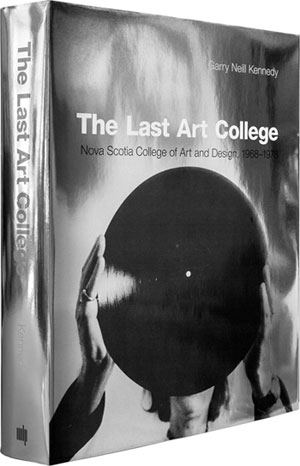
Information technology's what you phone call a weighty tome. From the provocative title and the I Volition Not Make Any More Boring Art endpapers and the 454 pages in between, Garry Neill Kennedy's The Last Art College, Nova Scotia College of Fine art and Design, 1968-1978 gives the reader enough to ruminate over.
In the year since its publication by MIT Press, the book has amassed a posse of solid reviews and made the Institute of Contemporary Arts' Book of the Year list. A review in The Builder's Newspaper calls it "Kennedy's greatest work to engagement as a conceptual artist. He has establish a manner to make the college's vision and material production stand the examination of time."
Reached by phone in Vancouver where he was squad instruction a graduate seminar at Emily Carr University of Fine art + Design with his wife Cathy Busby, the venerable onetime president spoke about the Nova Scotia College of Art and Design then and at present. He is at present in Europe where he is talking almost the volume to students at the University of Leeds, Teesside Academy and the Royal College of Fine art.
The following Q and A is based on an e-mail and phone conversation.
Where did the championship, The Terminal Fine art Higher, come up from?
It came equally a event of a chat that we (Roger Conover and his married woman Eda Cufer, my wife, Cathy Busby and me) had at the Algonquin Hotel, St. Andrews Northward.B. every bit that was half-way indicate between the residence of my editor, who lives in Freeport, Maine, and my dwelling in Halifax N.South. Several ideas for titles of the book were tossed around—remembering that MIT Press had already published books on the Bauhaus in Germany and Black Mountain Higher in the States— and more recently published The Art School (2011) for which I wrote a testimonial on its back cover.
What has been the reaction to the title?
There have been various responses to the title. At first MIT marketers had a trouble with information technology equally art schools are very popular these days —and they worried that it would be a difficult sell. Merely I said that all one has to do is flip through the volume and it would exist clear (to anyone who knows annihilation about fine art or fine art education or who went to NSCAD) that that there would be goose egg to compare to it in the future. It was "an artists-run fine art college."
What fabricated those years and then special?
Nosotros were aware that what we were doing was distinctive and important. (In the book, GNK elaborates on his vision to "create weather" whereby the best young artists from North America and Europe would make both long and short visits. Also, he sought to attract active professional person artists and designers as permanent faculty.)
To me, it'southward not enough that visiting artists come and requite a talk about their work. They've got to come and practise something with the students. Make a volume. Make a impress edition. Organize an exhibition. Exercise something! And so they came and they were office of the program.
Information technology would seem that the college's location in Halifax was a disadvantage in terms of plugging into the contemporary fine art scene. But you didn't see it that style. Why non?
In a talk given at the higher in November 1969, the New York critic Lucy Lippard described the special and somewhat paradoxical possibilities of the times. By sidestepping traditional art institutions with their rigid and decision-making hierarchies, she argued, visual artists could be more innovative. She pointed to the unique opportunities bachelor to artists working in environments that lacked the structures and attendant limitations of more established art centres … that fit with my thinking, there were few barriers to break down, few art traditions to uphold. There was no city or provincial fine art gallery, and there were no curators and few critics.
What do you hope the reader will get from reading your book?
Some people come across the book equally a claiming. We discussed it recently at a meeting of students and faculty at the Otis art Found in LA and one faculty fellow member said that it was a challenge to try to better.
Are there any lessons for NSCAD today from the NSCAD of the past?
In that location are a lot of lessons. The cardinal 1 is to avoid debt. The NSCAD of today somehow got itself into debt. In all my years at the captain, the Board saw that one of its main responsibilities was to keep the higher out of debt.
Debt is very simple. Y'all spend more than than you accept. Nosotros never spent more than we had—NEVER! If you allowed a corporation to get into debt then it's vulnerable to a takeover. The aforementioned goes for art colleges.
The other thing is to stay focused on what you do best. Don't have too many courses, too many departments. Stick to art and craft and design. If you get involved in too many things, and then you're going to have issues.
I think the schoolhouse could be amend. I think there's a lot people tin acquire from the book.  The Last Art Higher: Nova Scotia College of Fine art and Design, 1969–1978
by Garry Neill Kennedy
The How did a small art higher in Nova Scotia become the epicenter of art instruction—and to a large extent of the postmimimalist and conceptual art world itself—in the 1960s and 1970s? Like the unorthodox experiments and rich human being resources that made Black Mountain College an improbable center of art a generation earlier, the activities and artists at Nova Scotia College of Art and Design (NSCAD) in the 1970s redefined the means and methods of art educational activity and the shape of art far beyond Halifax.
Publication details:
Hardcover, 480 pages, 191 color illus., 410 b&westward illus., 8.5 x 11".
ISBN: 978-0-262-01690-2
Publication Appointment: April 2012
Co-Published past MIT Printing and the Art Gallery of Nova Scotia
hanselmanwitelabacter.blogspot.com
Source: https://nscad.ca/the-last-art-college/
0 Response to "The Last Art College Nova Scotia College of Art and Design 19681978"
Post a Comment