Hwo Did Jimmy Page Have a Baby With
How Jimmy Page was reunited with his beloved 1960 Les Paul Custom – nearly l years later it was stolen
In April of 1970, fresh off the triumph of their commencement 2 albums, Led Zeppelin were touring Due north America for an astounding fifth time in two years. The quartet was determined to become the biggest band in the world, and there was every indication that they were well on their way.
Their alive shows had become the stuff of fable, breaking omnipresence records, and on this detail ane-month jaunt, they would gross a full of more $ane,200,000 – roughly $8 one thousand thousand in today's money. But their feel on tour was non without its glitches. And a major i was the U.S. South and its still ultra-bourgeois mores.
"It was my dream to play Memphis," Jimmy Folio told Guitar World dorsum in 2008. "I grew upwards loving the music that came out of [at that place] and Nashville. Simply it turned out to exist really depressing. We arrived in Memphis and were given the keys to the city [because] the mayor was astonished at how quickly 'this Led Zeppelin boyfriend' had sold out the local loonshit. It occurred to him, whoever this 'guy' was, he must be important.
"Nosotros got the keys in the afternoon, only I guess they didn't like the looks of usa. Shortly afterwards, we were threatened and had to get the hell out of town as shortly equally nosotros were done with the show. I was really mad considering in that location were all these places I wanted to become – Sun Studios, where Elvis Presley had recorded, and and so on. They didn't like the long hair at all, man. Information technology was seriously redneck back then."
"So we played Nashville the following dark. Nosotros were in the dressing room, getting ready to go out and practise an encore, and this guy walked in and he said to us – 'If you guys go back out there, I'g gonna bust your heads.' And he wasn't kidding. We were function of a subculture [they] didn't want the kids to know about – hippies with long pilus."
- xx means to play guitar similar Jimmy Page
- Jimmy Page's 20 greatest guitar moments
Only Page and the band's unnerving adventures in the South were a mere crash-land in the road compared to what happened a couple of weeks later, far to the n. Toward the end of the group'southward month-long American trek, they traveled from Minneapolis to Montreal, Canada.
Crossing the border was ofttimes a hassle for rock and gyre groups, as Canadian customs officials often spent extra time going through their equipment, searching for contraband. To avert the bother, Led Zeppelin frequently chose venues close to the edge and so their Canadian fans could see them in the States. But this fourth dimension they decided to seize with teeth the bullet and fly to Montreal.
Everything went surprisingly well until Folio noticed that something was missing: his prized black 1960 Gibson Les Paul Custom – a deeply personal favorite he had used since his early on days every bit a tiptop British session musician. "We went over the border, merely my 'Black Beauty' didn't turn upwardly at the other cease," Page recalls in his new book, Jimmy Page: The Anthology.
"At that place were and so many points in the journey where it could've gone missing – at the original airdrome, at customs, at the airport in Canada – just all I knew was that information technology wasn't there, and in those days, nobody could trace it. Nosotros played the concert in Montreal and there was however no news on the electric guitar. It had evaporated."
After he was certain information technology had been stolen, Page did the only thing he could think of, which was to have out a "missing guitar" advert in Rolling Rock that ran in every event for the next year.
Unfortunately, the but response he received was silence, and thus began 1 of music history's biggest mystery stories – a perplexing whodunnit that about thought would never be solved.
In the Beginning
To appreciate the guitar'south significance to Page, nosotros accept to travel dorsum to England in the late Fifties. During that time, Page played in several exciting London stone and blues bands, like Ruby-red E. Lewis and the Redcaps and Neil Christian and the Crusaders, while experimenting with different guitars and sounds.
Afterward cutting his teeth on ii serviceable instruments, a 1958 Hofner President and a Czechoslovakian-fabricated 1959 Grazioso Futurama, Page moved on to a pro-level sunburst Fender Stratocaster.
The Strat was a fine guitar, but the immature Page wasn't quite fix to settle downwardly with one musical instrument. Enamored with the fingerpicking style of country superstar Chet Atkins and rockabilly guitarist Cliff Gallup'south apply of the Bigsby tremolo, Page acquired a 1960 Gretsch Chet Atkins 6120 model featuring a cute and highly figured, flamed maple top and a Bigsby.
"I was bang-up to be able to play [like Atkins]," Folio said. "And Paul Bigsby was an boggling innovator, and there's a totally different mechanism on his tremolo arm compared to the one on a Stratocaster. The combination… was plenty for me to go up to London, play [a Gretsch 6120] in the shop and trade in the Fender Stratocaster."
It seemed similar Page had establish his platonic guitar, but several months later on he was walking down Charing Cross Road in London and decided to cease past Lew Davis, a small music shop that doubled equally an informal gathering spot for local musicians. There he saw something that literally stopped him in his tracks, made his palms sweat and his centre beat a little faster.
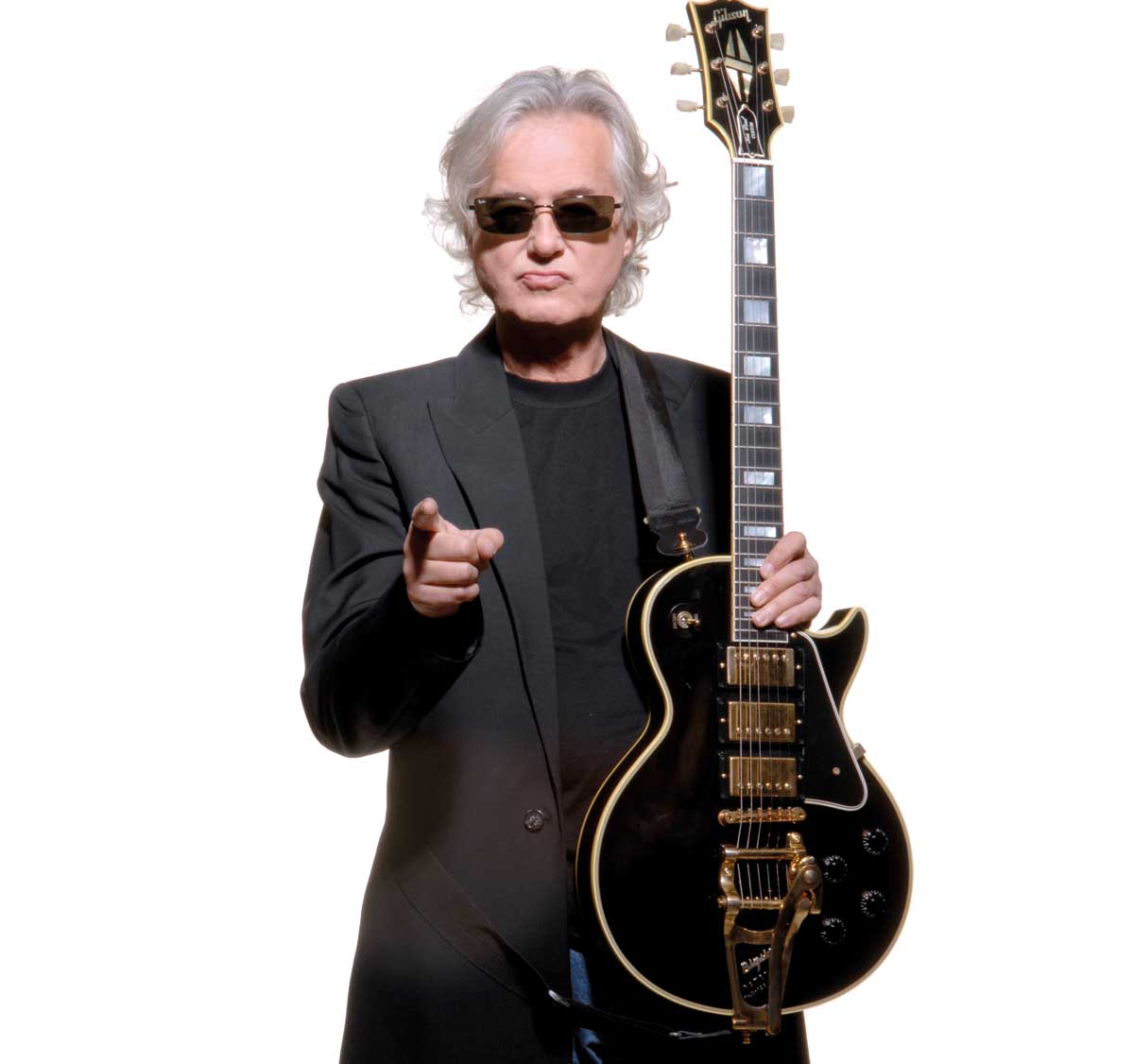
"There was this guitar hanging on the wall looking so bloody sexy," Page said of the new (1960) tuxedo-blackness, three-pickup Les Paul Custom with flashy gold hardware and a Bigsby tremolo. "Information technology was saying, 'Come on and then. Come on, stop looking and ask them if you can play me.' I played information technology unplugged for quite a while. And so when I plugged it in it was similar a dream, and I knew this was information technology. It sounded extraordinary. I knew it was coming home with me." .
At that place was this guitar hanging on the wall looking so bloody sexy. When I plugged it in information technology was like a dream, and I knew this was information technology. Information technology sounded extraordinary
Jimmy Folio
Page wasn't sure how he was going to pay for the palatial instrument, simply something came up that eliminated those money worries enough then that he could have his dream guitar.
While playing at the Marquee, a small guild in the heart of the music manufacture in London's W Finish, he was headhunted to piece of work as a session guitarist for the Columbia Graphophone Company and Decca Records.
His starting time session for Decca was the recording Diamonds, past Jet Harris and Tony Meehan, which went to Number Ane on the U.M. singles chart in early 1963, and soon Folio became one the virtually in-demand studio guitarists in England
Legendary producer Shel Talmy was especially impressed past Page'due south command of rock and blues, and he asked him to play on the Kinks' 1964 debut album and the Who'south landmark first single, I Tin't Explicate. But that was just the tip of the iceberg.
Jimmy and his Les Paul Custom can be heard on literally hundreds of tracks from that era, including Shirley Bassey's dramatic Goldfinger and Them's intense garage rock version of the blues classic, Baby, Please Don't Go. And so busy was he that information technology's estimated that his guitar can be heard on 60 pct of the tracks recorded in United kingdom in the early Sixties.
"I'd used it to play those Eddie Cochran numbers and it was a real good backup guitar to have. It really sounded terrific. It was a jump of organized religion to take the guitar on the road… and expect what happened"
Jimmy Page
With its iii humbucking pickups, the black Les Paul afforded Folio wide tonal flexibility, making the musical instrument perfect for just about anything he was called on to play.
It was with this guitar that Page built his reputation and became ane of the most respected players in England. 1 can only imagine the professional and emotional value he placed on the instrument.
Perhaps one indication of the guitar's significance to him is that when he somewhen moved on to playing in the Yardbirds and Led Zeppelin, he well-nigh never took information technology on the road with him, unwilling to take whatever risks with the musical instrument. In fact, the fateful 1970 North American tour was the first time he dared travel with it for an extensive period of fourth dimension.
"I was using my sunburst Les Paul Standard I bought from Joe Walsh in 1969," Page told Guitar World, but I sort of plucked up the backbone to take the Custom guitar on bout with united states, because when we did the Regal Albert Hall testify [captured in its entirety on 2003'south Led Zeppelin DVD], I'd used it to play those Eddie Cochran numbers and it was a existent proficient backup guitar to have. It really sounded terrific. Information technology was a bound of religion to have the guitar on the road… and await what happened."
The heist
What did happen? That was the million-dollar question. For the next 20 years Page and his associates searched in vain for whatsoever sign of the instrument, with no luck.
Then, i day in the early Nineties, at that place was an indication that the real guitar may accept finally surfaced. Nate Westgor, the possessor of Willie's American Guitars, a well-regarded St. Paul, Minnesota, vintage guitar shop, had a curious encounter.
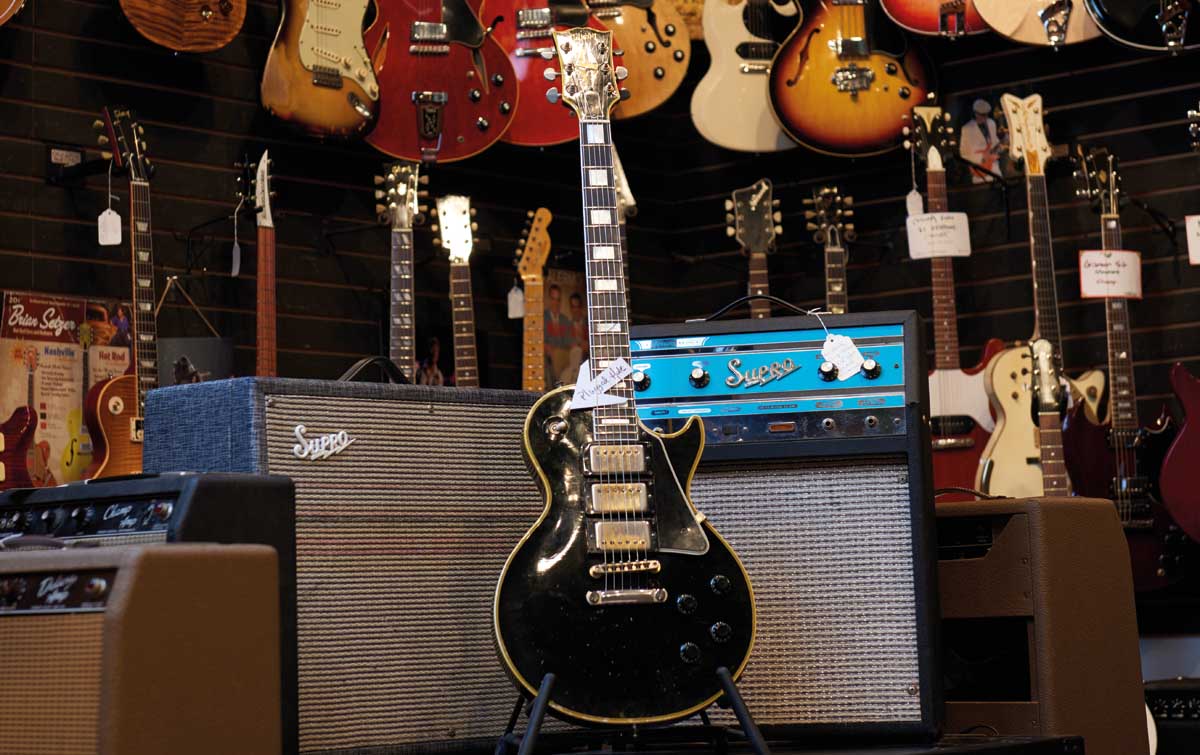
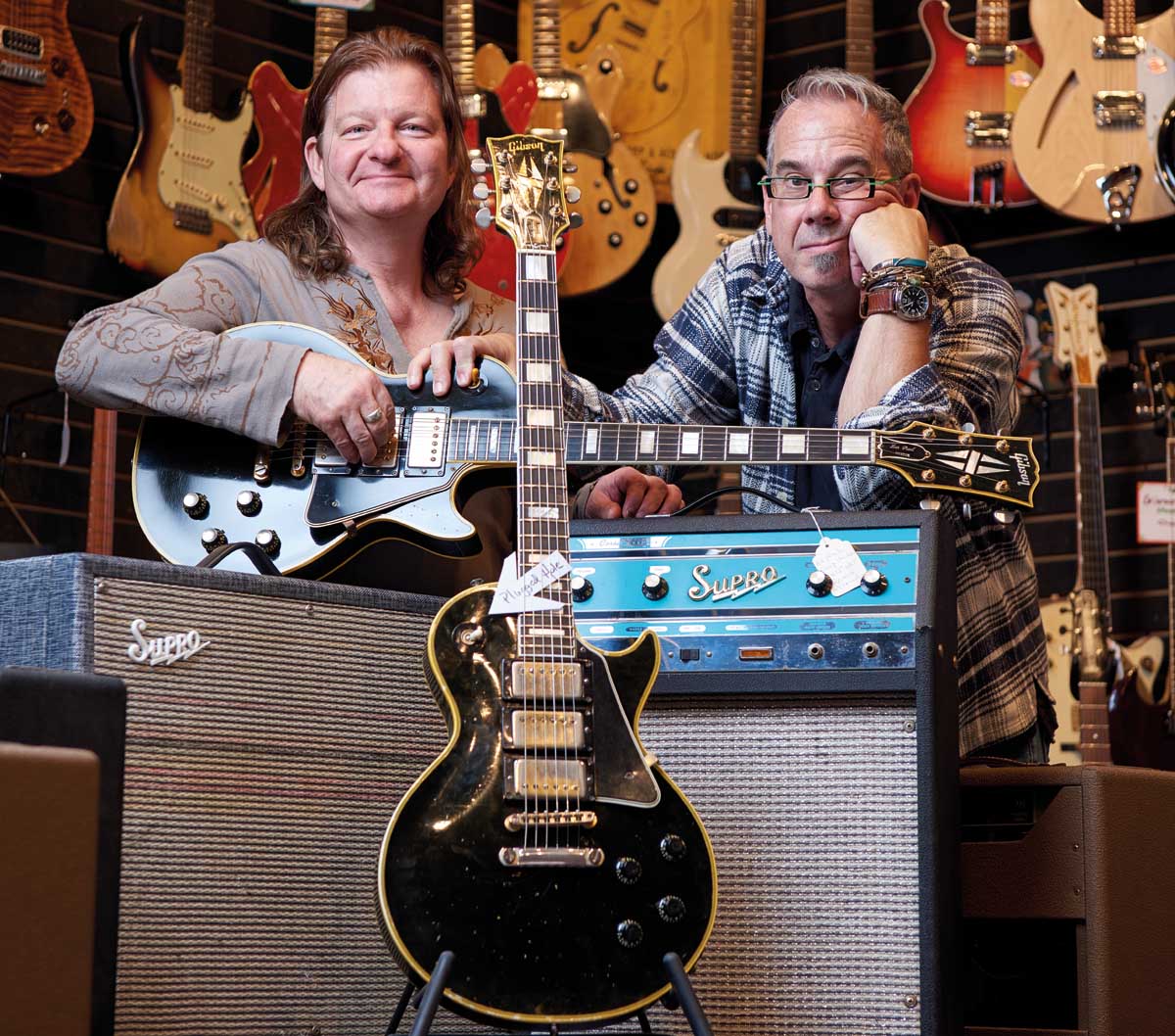
"A guy I had never seen before walked in the store with a 1960 Les Paul Custom and said, 'I have Jimmy Page's stolen guitar,'" remembers Westgor. "To be honest, I didn't believe him. At that place was no internet dorsum and then, and so there was no easy mode to check out his claim.
"And all those ads Jimmy ran in Rolling Stone years ago weren't readily bachelor, and then nosotros didn't have the serial number or frame of reference. I was skeptical, but it was a dainty guitar, then I offered to consign it while I promised to dig around. When I asked him how he got the guitar, his story was just weird plenty to make me think at that place might be something to information technology."
Co-ordinate to the customer, whose name has been lost over fourth dimension, he obtained the Les Paul from the widow of a Minneapolis aerodrome employee who'd stolen the guitar in 1970 when Zeppelin came through town, and so kept it nether his bed until he died. "He bought the guitar for $5,000 from the adult female, and he just wanted his money back and to go [information technology] back to Jimmy," Westgor says.
The store owner's first call was to one of Page'south confidants, producer and guitar collector Perry Margouleff. Margouleff was on the East Declension at the time and asked Peter Alenov, a respected St. Paul-based guitar dealer who sold instruments to the likes of Keith Richards and Eric Clapton, if he would check out the guitar on his behalf.
This is where the story should accept ended happily for Jimmy. Simply it didn't, every bit his dearest guitar again went missing – for some other two decades.
A guy I had never seen earlier walked in the store with a 1960 Les Paul Custom and said, 'I take Jimmy Page's stolen guitar. I didn't believe him. There was no internet back then, so there was no easy way to check out his merits
Nate Westgor
The Toggle Switcheroo
Few photos of Page with his Les Paul Custom existed, so just a scattering of people knew that information technology had been modified.
A typical iii-pickup Custom comes with a unmarried three-mode toggle switch that allows players to activate their pickups in this fashion – cervix pickup only; neck and middle pickup; bridge pickup only. Jimmy, however, added two additional toggle switches and then he could actuate any combination of pickups, change their phase relation or turn them off completely .
When Perry asked Alenov to inspect the instrument, he didn't tell him about the extra switches. "Pete really knew his stuff and I trusted him implicitly," Margouleff told Guitar World, "but I didn't depict the instrument in any detail. I didn't want to color his observations."
If the guitar had been refinished in the Seventies or something, that repair piece of work would have had time to sink in, and Pete was a very sharp guitar guy, he would have spotted it
Perry Margouleff
"He called me upwards and he said, 'I'm looking at this guitar. Information technology's a black 1960 Les Paul Custom… information technology's totally stock. It's got a Bigsby, foil cap knobs…' and so on… I said, 'Thank you a lot. You tin can get home at present, we're washed.' I didn't need to hear anything else because I knew the guitar was supposed to have 3 toggle switches on information technology.
"If the guitar had been refinished in the Seventies or something, that repair work would accept had fourth dimension to sink in, and Pete was a very sharp guitar guy, he would accept spotted it. He would take said, 'Hey, I see some evidence of some repair work on this guitar.' He certainly would've noticed the extra toggle switches, just he didn't say anything similar that.
"After he inspected the guitar I spoke with Nate, the store owner, and said, 'That's not the guitar, but thanks for checking, I'll meet y'all afterward.' So, he sold it to a kid who was working in his music store for $5,000."
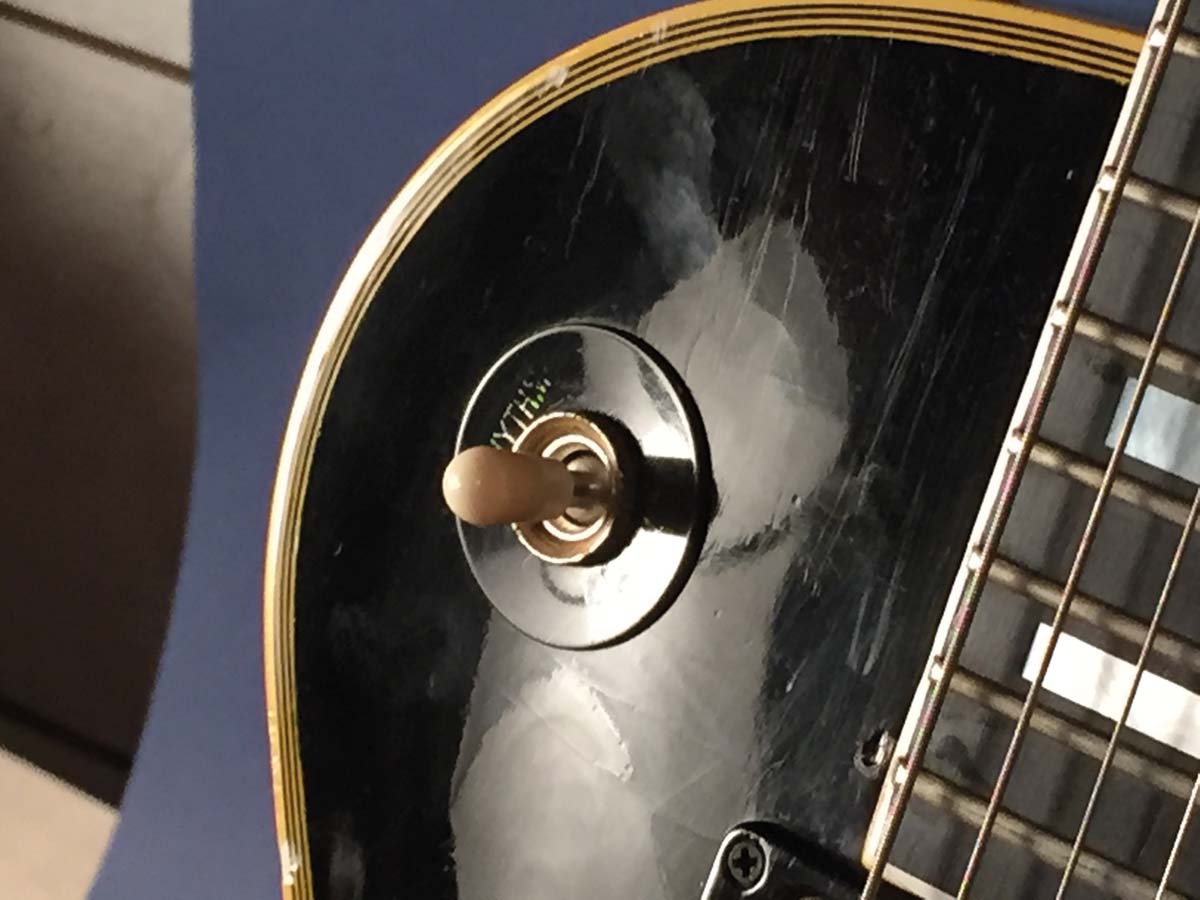
False Alarm?
It turned out, however, that Margouleff and Alenov were mistaken. Every bit Margouleff would learn 20 years afterwards, the guitar was indeed the existent deal, but it had been spectacularly refinished to mask the fact that it had been stolen. All traces of the iii switches had been expertly obliterated, fooling even a top good like Alenov. The "kid" that ended up with the guitar was a young punk rocker named Paul "Bleem" Claesgens. He cruel in love with the Custom, but as Page did years earlier.
It was a great guitar – and information technology was in a store loaded with great guitars. I was just pining for it. I really ended up owning information technology longer than Jimmy did!
Paul "Bleem" Claesgens
"I looked at the guitar every solar day when I walked in," says Claesgens, who plays in the Minneapolis band Brass Elephant. "I'd pull it off the wall, play it and go, 'My God, why don't I own this?' It was a great guitar – and it was in a store loaded with smashing guitars. I was just pining for it. One day a credit card came in the post, and I said, 'Hey boss, guess what? I'm buying this guitar.' And he said, 'Oh yeah, go for information technology, man.' I actually ended up owning it longer than Jimmy did!
"I recorded tunes with information technology. I dragged information technology all over the Midwest in diverse bands and even used it to defend myself from flight beer bottles! Information technology'south kind of amazing that Jimmy Page's lost guitar sabbatum on stages effectually Minneapolis and nobody knew."
At some signal, Claesgens replaced the guitar's distinctive Bigsby tremolo with a stop tailpiece, which obscured the musical instrument's identity fifty-fifty further. Just in 2014, he had a mishap with the guitar that set into motion a series of events that would send the guitar back to its original owner.
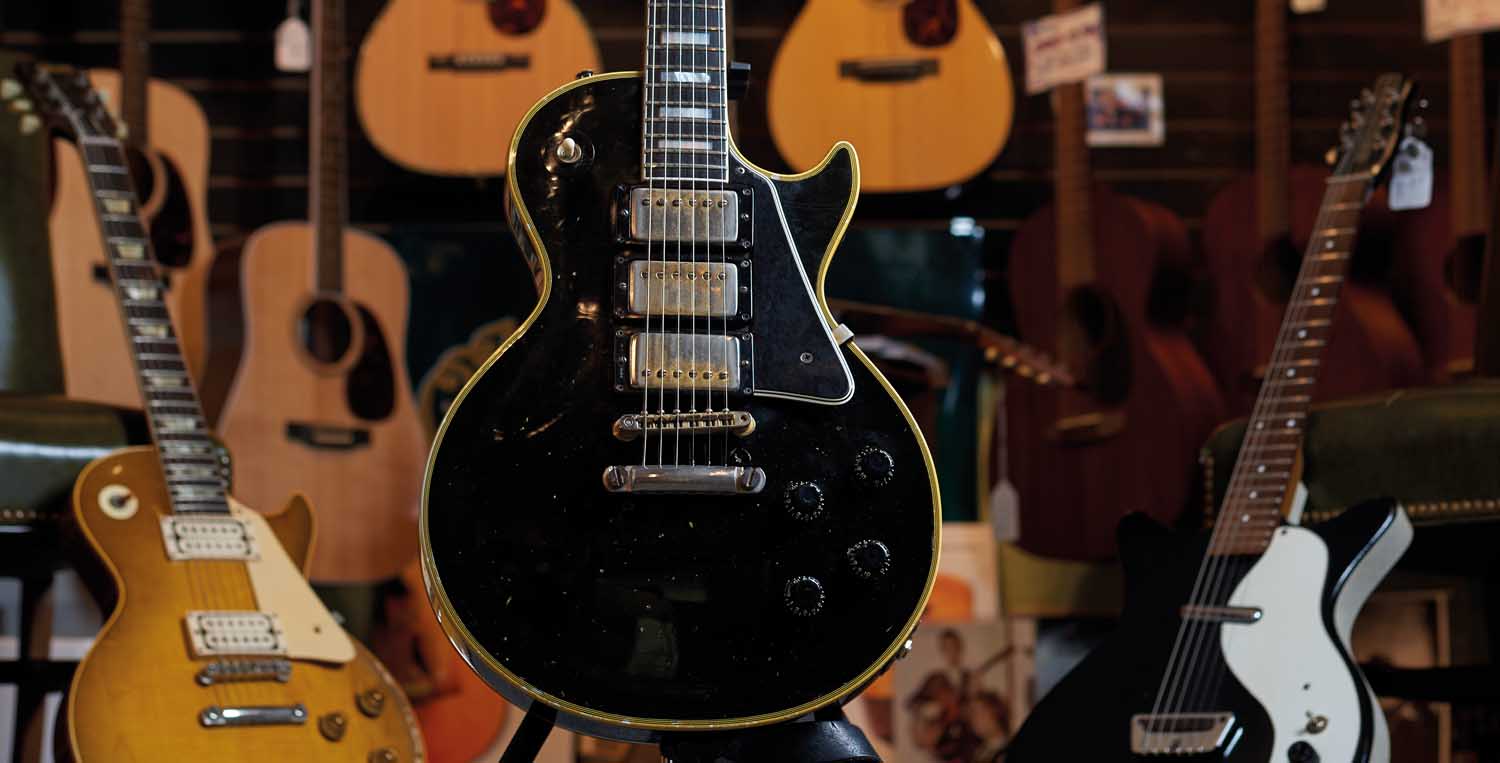
One evening, Claesgens was "showing off" when his friends dared him to perform a risky stage move straight from his personal rock and roll celebrity days. "I took the guitar and whipped information technology around my shoulder similar a hula hoop then it would come dorsum around, which was something I used to practise all the time at shows – a total rock star move," he laughs. "Simply this time it just flew off, and blast – I looked down and it was cleaved. The headstock just snapped."
I looked at information technology for, similar, 20 minutes, simply I knew in my heart information technology probably was really Jimmy'southward guitar after all
Nate Westgor
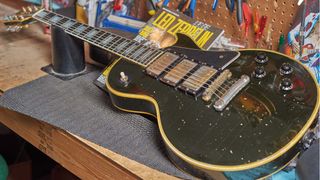
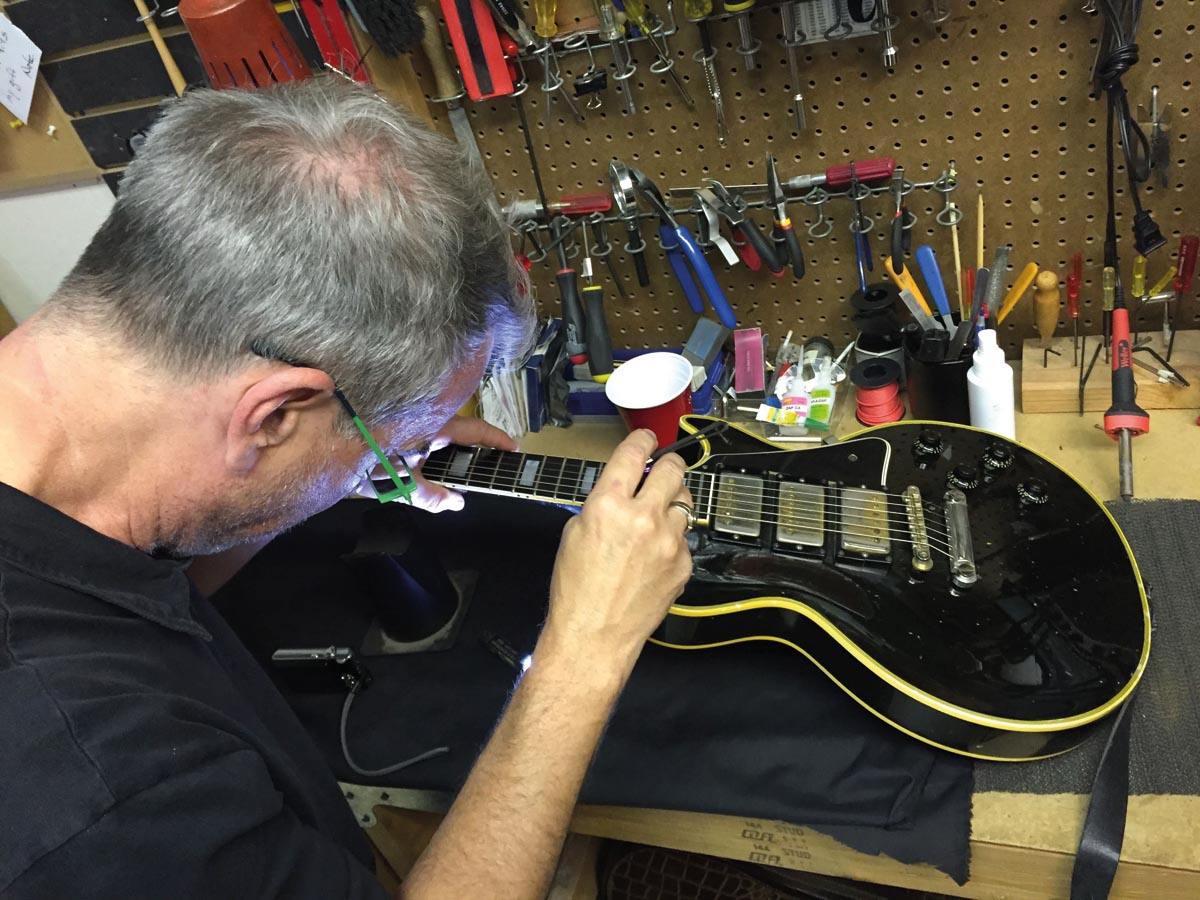
After a quick assessment of the damage, he brought the guitar back to Willie's American Guitars, where much of this story began. That evening, owner Nate Westgor put the cleaved instrument on his workbench and, remembering the guitar's earlier history, just for the hell of it, decided to re-examine information technology closely.
Thank you to the cyberspace, Westgor now knew about the additional toggles Page had installed on his guitar in the Sixties. He carefully scanned – with a blackness low-cal – the area where the switches would've been, and he was stunned by what he saw.
"The mahogany on the back had actually sunk a bit," says Westgor, recalling a moment he admits still gives him chills. "The back holes were bigger, but you could just grab it if you turned the guitar at but the right angle in the light. I looked at it for, like, 20 minutes, simply I knew in my heart information technology probably was really Jimmy's guitar later all.
"I gave information technology back to Bleem [Claesgens] and told him what I suspected, and I merely figured he'd demand some fourth dimension to digest that. Then I got back in affect with Perry Margouleff, and he said, "How are we going to figure this out?"
Black Dazzler Rides Again
Margouleff was intrigued with Westgor's discovery, only he was however not convinced it was Jimmy's guitar.
He called Page direct and said, "Wait, they said you lot can see evidence where the switches were, simply I can't guarantee it ways anything. It could however be a apocryphal. The only way nosotros could actually ensure that the guitar is for real is if nosotros could friction match upward the grain patterns in the mother-of-pearl inlays with a photograph."
When I first met Jimmy over xx years ago, we went out to lunch and he said to me, 'I'd like you to discover my Les Paul Custom for me'
Perry Margouleff
But the problem was, every existing photo Margouleff had of the instrument was shot with a flash, so the image of the inlays lacked detail. And so Page had a brilliant idea: He went through his archives and establish a 60-second film clip from Led Zeppelin's performance at the Royal Albert Hall in 1970, where the camera man zoomed in on his left mitt, making it possible to run into the inlay at the 12th fret of Black Beauty with smashing clarity.
Fortunately, the inlay had a readily identifiable dark stripe – and bingo! "I had a photograph of the guitar that Nate sent me, and the inlay perfectly matched Jimmy'due south guitar from the pic clip," Margouleff says.
"I said, 'Well, fuck, that's information technology.' At that place'due south no chance that two guitars would have that same stripe in the mother-of-pearl in the aforementioned spot. Information technology would never happen. When I first met Jimmy over 20 years ago, we went out to tiffin and he said to me, 'I'd similar you to notice my Les Paul Custom for me,'" says Perry, shaking his head. "It was almost every bit if he knew I would detect it somewhen."
Fifty-fifty though the guitar was a stolen musical instrument, Margouleff and Page agreed that Claesgens deserved to be compensated. But how much? The $5,000 he paid for it seemed as well lilliputian. The duo came upwardly with a novel solution. They plant some other completely clean, vintage 1960 Les Paul Custom with a Bigsby, worth approximately $70,000 in today's market, and made a swap. While Claesgens was sad to meet his companion go, he was satisfied with the organisation.
Celebration Solar day
Margouleff carried the missing guitar by hand to England and finally presented it to Folio at his dwelling house in London. They sat and had a cup of tea while Perry talked most the unabridged take chances, and then, after about 20 minutes, Jimmy got upwardly and said, "Okay, I can't conduct it anymore. I have to come across it."
I told Jimmy that Bleem and I were then glad to be able to return the guitar to its rightful owner, and that I was nonetheless a little nervous that the guitar might not be his
Nate Westgor
The legend then had a Phonation AC30 that he had owned ever since his early days in the Yardbirds brought to his house, plugged in the guitar and played it for a while with a grinning that refused to leave his face. After having another cup of tea, Perry suggested he phone call Westgor and give thanks him personally.
"It was 10:30 in the morning, and I was running late for a dentist appointment when the telephone rang," Westgor says. "It was Perry Margouleff, who said, 'I'm here with someone who is very happy. Here, let me put him on.' I said, 'Oh, Jimmy I'g thrilled to hear from you.' Suddenly, my phonation sounded like I was fifteen years old.
"I told Jimmy that Bleem and I were so glad to be able to return the guitar to its rightful owner, and that I was still a little nervous that the guitar might non be his. But he reassured me that when he got his hand around the neck, he knew [it] right away. … Then he said something I'll never forget: 'It'due south going to be with me [from now on]. Information technology will not get out my side."
Play It Loud!
But there's some other mystery surrounding the Black Beauty. If Page recovered the guitar in 2015, why did it have iv or five years for him to reveal information technology? Co-ordinate to Margouleff, the guitar was so of import to Jimmy, he only wanted a special way to reintroduce information technology to fans and the world.
"There'll exist a real reason to bring this out into the earth," Jimmy told him enigmatically, "and that'southward when people should know about information technology." Page was right. That opportunity came in April 2019, when the Metropolitan Museum of Art in New York Urban center held an incredible exhibition starring the most legendary instruments in stone and roll history, Play It Loud.
In addition to guitars owned by Chuck Drupe, Keith Richards, Stevie Ray Vaughan and Eddie Van Halen, a big portion of the exhibit was devoted to Page's iconic instruments, amps, effects and stage article of clothing.
And smack in the center, to the astonishment of his fans, was the long-lost Custom. Similar the obelisk on the cover of Led Zeppelin's Presence, the guitar seemed to have appeared out of nowhere.
Somewhen some data about its odyssey began trickling out from Minneapolis, and Folio revealed more in Jimmy Page: The Anthology. Now, thanks to Folio, Margouleff, Westgor and Claesgens, nosotros've finally been able to present the most comprehensive business relationship to date.

Thank yous for reading five articles this calendar month*
Bring together at present for unlimited access
US pricing $iii.99 per calendar month or $39.00 per year
UK pricing £2.99 per month or £29.00 per twelvemonth
Europe pricing €3.49 per month or €34.00 per yr
*Read v costless articles per month without a subscription
Bring together now for unlimited access
Prices from £2.99/$3.99/€three.49
hanselmanwitelabacter.blogspot.com
Source: https://www.guitarworld.com/features/how-jimmy-page-was-reunited-with-his-beloved-1960-les-paul-custom-nearly-50-years-after-it-was-stolen
0 Response to "Hwo Did Jimmy Page Have a Baby With"
Post a Comment